DGM-Turkey
Home News Blog Careers Contact
Get Quote
Tüm Hizmetler

ADR · IMDG · IATA Certified

Class Labels & Hazard Marks

Supply of regulation-compliant hazard labels, hazard warning marks and special marks for all hazard classes.

We supply hazard labels and markings required on dangerous goods packaging and transport units in full compliance with ADR, IMDG, and IATA standards.

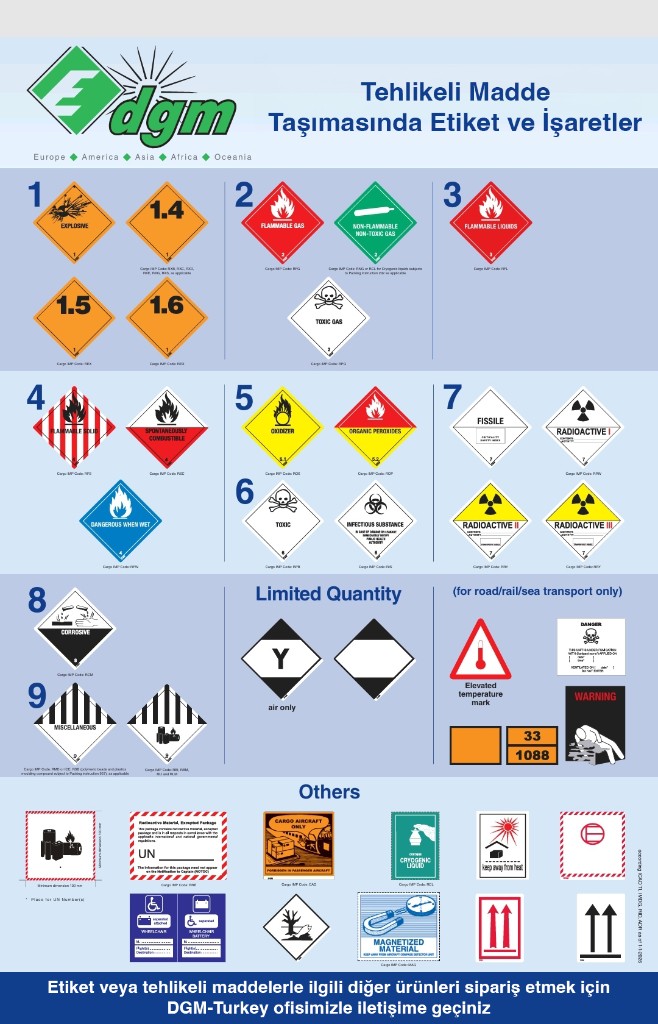
Hazard labels and marks in dangerous goods transport — reference chart
Summary of ADR · IMDG · IATA labels and marks.

Product Scope

  • ADR/IMDG/IATA hazard class labels (Class 1–9)
  • Subsidiary risk labels
  • Environmentally hazardous substance mark
  • Orientation labels (arrow labels)
  • LQ (Limited Quantity) and EQ (Excepted Quantity) markings
  • Elevated temperature, “Keep Away from Heat”, and “Keep from Freezing” labels
  • Options available in various sizes (100×100 mm, 250×250 mm)

The 9 Hazard Classes — Pictograms and Meanings

ADR, IMDG and IATA regulations group dangerous goods into 9 main classes based on their physical, chemical and biological hazards. Each class definition, label colour and representative substances are summarised below.

1

CLASS 1

Explosives

Solid or liquid substances capable of chemical reaction producing gases at such a temperature, pressure and speed that cause damage. Subdivided into 1.1–1.6 with different quantity, compatibility and storage rules. Label colour: orange, with exploding bomb symbol.

Example: Dynamite (UN 0081), sporting ammunition (UN 0323), fireworks (UN 0336), airbag inflator (UN 0503).

2

CLASS 2

Gases (Compressed, Liquefied and Dissolved)

Divided into 3 subclasses. 2.1 Flammable gases (red label): propane, butane, acetylene. 2.2 Non-flammable, non-toxic gases (green label): nitrogen, argon, carbon dioxide. 2.3 Toxic gases (white label, skull symbol): chlorine, ammonia, hydrogen cyanide.

Example: LPG (UN 1075), oxygen (UN 1072), aerosols (UN 1950), chlorine (UN 1017).

3

CLASS 3

Flammable Liquids

Liquids with a flash point at or below 60 °C. Label colour: red, flame symbol. No subdivisions; the packing group (PG I, II, III) is determined by flash point and initial boiling point.

Example: Petrol (UN 1203), ethanol (UN 1170), acetone (UN 1090), paint thinner (UN 1263), diesel fuel (UN 1202).

4

CLASS 4

Flammable Solids · Spontaneously Combustible · Dangerous When Wet

4.1 Flammable solids (red-and-white vertical stripes): matches, naphthalene, sulphur. 4.2 Spontaneously combustible (upper white, lower red): white phosphorus, oily absorbent rags. 4.3 Dangerous when wet (blue label): sodium, lithium, calcium carbide.

Example: Sulphur (UN 1350), sodium (UN 1428), calcium carbide (UN 1402).

5

CLASS 5

Oxidizing Substances · Organic Peroxides

5.1 Oxidizers (yellow label, flame over circle): release oxygen that causes other materials to burn. 5.2 Organic peroxides (upper red, lower yellow): thermal instability requires temperature-controlled transport.

Example: Ammonium nitrate fertilizer (UN 2067), hydrogen peroxide ≤ 60% (UN 2014), benzoyl peroxide (UN 3102).

6

CLASS 6

Toxic Substances · Infectious Substances

6.1 Toxic substances (white label, skull-and-crossbones): lethal by ingestion, inhalation or skin contact. 6.2 Infectious substances (white label, biohazard symbol): clinical samples and waste containing pathogens.

Example: Sodium cyanide (UN 1689), pesticide (UN 2902), clinical waste (UN 3291), Category A infectious substance (UN 2814).

7

CLASS 7

Radioactive Material

Substances emitting ionizing radiation. Label is half-yellow and half-white with trefoil symbol. Marked in three categories according to radiation level: I-White, II-Yellow and III-Yellow. Transport is governed by the national nuclear authority and IAEA rules.

Example: Uranium hexafluoride (UN 2977), medical isotopes (UN 2915), X-ray equipment.

8

CLASS 8

Corrosive Substances

Liquid or solid substances that cause damage to skin and metals on contact. Upper half white, lower half black, with a symbol showing liquid dripping onto a hand and metal.

Example: Sulphuric acid (UN 1830), sodium hydroxide — caustic soda (UN 1824), lithium battery electrolyte, hydrochloric acid (UN 1789).

9

CLASS 9

Miscellaneous Dangerous Substances and Articles

Substances and articles presenting a hazard during transport but not covered by the other 8 classes. White label with 7 vertical black stripes at the top. Lithium batteries, magnetic materials, elevated-temperature substances and environmentally hazardous materials fall in this class.

Example: Lithium-ion battery (UN 3480/3481), dry ice (UN 1845), asbestos (UN 2212), airbag module (UN 3268).

Regulatory Basis: ADR Chapters 5.2 and 5.3, IMDG Code Chapter 5.2 and IATA DGR Chapter 7 define the size (minimum 100×100 mm; 250×250 mm placards for vehicles and containers), colour, symbols and placement rules of hazard labels.

Entrust Your Operational Safety to Professionals

Contact our expert team for regulatory compliance, packaging solutions, or technical consultancy.

Get Consultancy